I get this question a lot from founders: what's the ROI on my marketing, and how do I actually track it? And the honest answer is B2B just doesn't work like B2C. Nobody sees a LinkedIn post and buys enterprise software ten minutes later.
A new report from Dreamdata, a B2B attribution platform that pulled data from 3.5 million customer journeys, backs up something we've believed at Psyche Digital for a long time. The companies that win in B2B aren't the ones with the biggest sales team. They're the ones who did the work to earn trust before a salesperson ever got on the phone.
I don't want this to just be me repeating someone else's report back to you, so let's get the numbers out of the way first.
The short version, if you're skimming:
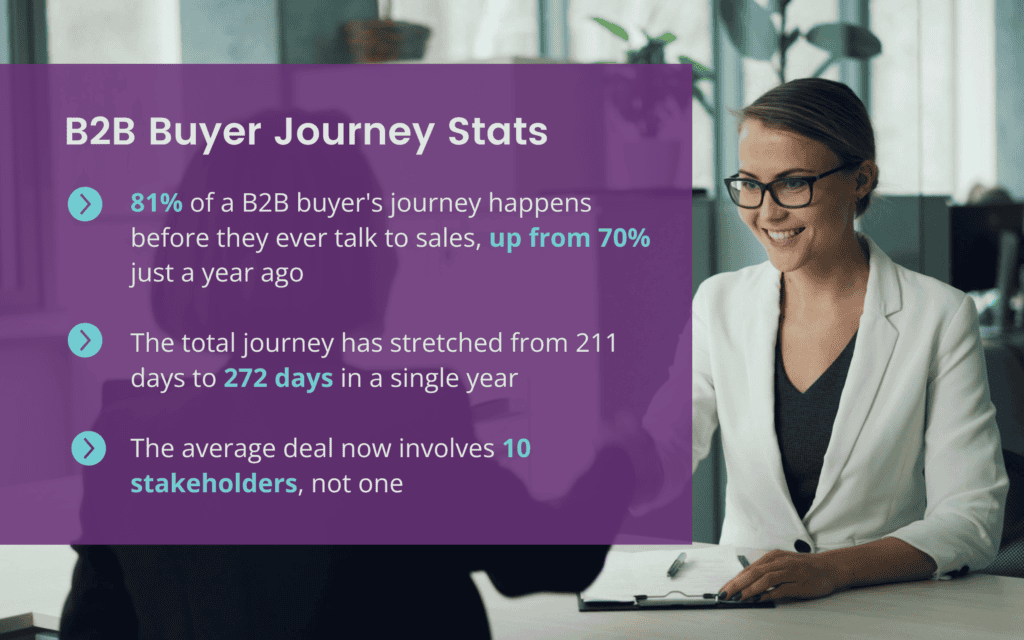
- 81% of a B2B buyer's journey happens before they ever talk to sales, up from 70% just a year ago
- The total journey has stretched from 211 days to 272 days in a single year
- The average deal now involves 10 stakeholders, not one
- All of this means your website and your content are doing the actual selling, long before your team gets a shot at it
Now let's get into what that actually means for you.
Your sales team barely gets a say
81% of the B2B customer journey happens before a prospect ever talks to a salesperson. A year ago that number was 70%. That's an 11-point jump in twelve months, which tells you this isn't slowing down.
That 81% is the whole stretch where someone's Googling you, reading your content, comparing you to your competitors, and deciding whether they trust you. Nobody from your team is in the room for any of it. If your website isn't earning that trust during that stretch, you're not in the running by the time that person is ready to buy. And you don't get a do-over on that.
The whole journey got longer. But not the part you'd think.
The average B2B journey, first touch to closed deal, grew from 211 days to 272 days in a year. That's a 61-day jump.
Here's the part worth paying attention to: the time buyers spend in the actual sales pipeline got shorter. So did the time it takes a lead to go from marketing-qualified to sales-ready. All of that extra time is happening before sales is even looped in.
So buyers are showing up later, but they're showing up way more prepared. The convincing that used to happen on a discovery call is now happening in your content, months before your team ever gets on a Zoom with them.
It's not a buyer. It's a committee.
The average deal now involves 10 stakeholders, up from under 7 last year, moving across 4 different channels. That's not one person doing a Google search on their lunch break. That's a group of people, each forming their own opinion on their own timeline, and most of them are never going to fill out a form or reply to an email.
This is why it drives me a little crazy when people talk about B2B marketing like it's just a lead-gen function. You're not trying to convert one person. You're trying to build enough credibility that ten different people, all doing their own research on their own time, land on the same conclusion about you without ever comparing notes.
So what actually builds that credibility?
If 81% of the decision gets made before anyone talks to you, the real question is: what are they finding when they look?
Here's what we actually believe matters, and what we build with our clients:
- A website that does the convincing for you. Not a digital business card. A resource that actually answers the questions a buying committee is asking, with proof behind it, not just claims.
- Case studies that make the outcome real. People want to see themselves in your existing customers. Specific results, specific problems, in language that sounds like how your best clients actually talk about you, not how you'd talk about yourself.
- Social proof, out in the open. A logo band of names people recognize, a few strong testimonials, evidence that other serious companies already made this bet. It's quiet work, but it's often exactly what a skeptical stakeholder needs before they're willing to go to bat for you internally.
- A real, consistent presence where your buyers actually are. For most of our clients, that's LinkedIn. I'm talking about organic content, not paid ads. Founders and team members showing up consistently with an actual point of view instead of a pitch. Even the report we're pulling from backs this up: the best-performing paid LinkedIn content is almost always just a boosted version of an organic post that was already working. If a post can't earn attention on its own, paying to push it out just means more people scroll past it.
What this means for your next board conversation
The next time someone asks you for the ROI on your marketing, or how to track it, here's the honest answer: 81% of what shaped your pipeline happened before your CRM ever had a chance to see it.
That is a reason to get deliberate about what you're actually building during that long stretch before sales gets involved. Your website, your case studies, your social proof, your presence on LinkedIn: none of that is a nice-to-have. It's revenue work, whether or not it shows up on a monthly dashboard. When your board asks about CAC or pipeline efficiency, they're really asking whether that early groundwork is any good.
The companies that win the next few years of B2B growth are the ones willing to invest in the 81% of the journey their sales team never even sees.
Source: Dreamdata, LinkedIn® Ads Benchmarks Report 2026.