
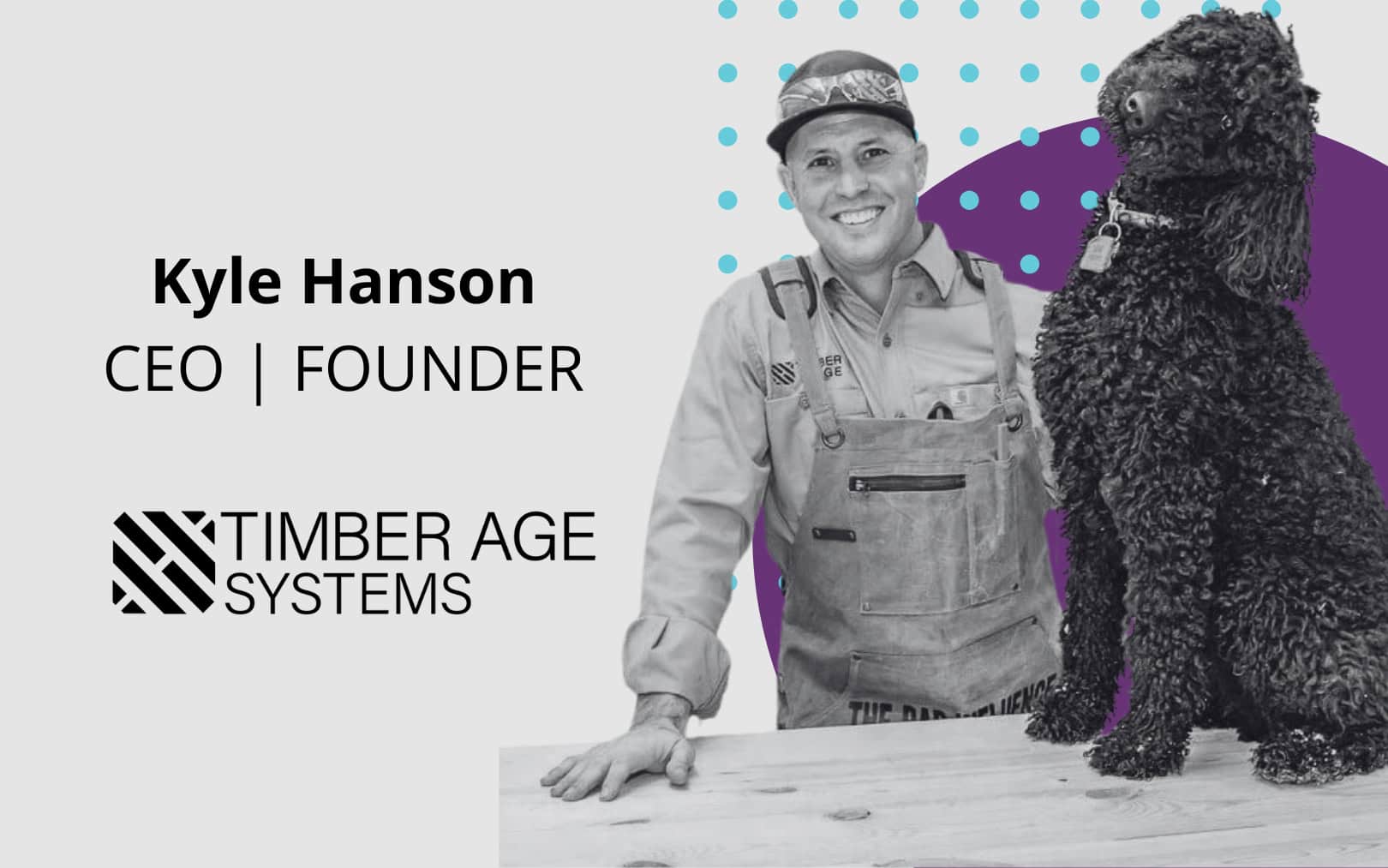
How Kyle Hanson and Timber Age Systems are using local wood and lean thinking to solve ecological, economic, and housing challenges in Southwest Colorado.
When Kyle Hanson walked away from a successful corporate career in manufacturing, he wasn’t running from something. He was running toward an idea he couldn’t shake: that the forests, people, and communities of Southwest Colorado deserved a better system and that he might be able to help build it.
Today, Hanson is the founder and CEO of Timber Age Systems, a Durango-based manufacturing company with an unusually holistic mission: to care for the forests, provide high-quality jobs, and produce sustainable building materials that address the region’s housing crisis. Timber Age™ manufactures housing panels using locally harvested Ponderosa pine, a tree species critical to forest health and wildfire resilience.
"We've got all of this wood the Forest Service doesn't know what to do with, and a shortage of affordable housing," Hanson said. "What if we could connect those dots?"
The answer became Timber Age™: a company that has grown from an idea hatched during a career sabbatical to a team of 18 full- and part-time employees. They produce cross-laminated timber (CLT) panels using underutilized wood species, helping reduce wildfire risk while also creating dignified, year-round jobs in a region where seasonal employment is the norm.
But the journey to Timber Age™ wasn't linear. Like many founders, Hanson's path was full of pivots, false starts, and unexpected mentors.
From Model Rockets to Mission-Driven Manufacturing
Hanson's early life in Montana was shaped by curiosity. "I was a geeky kid," he laughs. "Thick glasses, launching model rockets, small for my age, but I loved science and sports."
Neither of his parents had gone to college, but Hanson pursued a military scholarship with dreams of becoming an aeronautical engineer. That dream was dashed when his eyesight disqualified him from the Army ROTC program. What followed was a winding path through athletics, teaching, ski-bumming, and eventually graduating with degrees in biology and education.
His first career was in the classroom, where he taught high school biology and multimedia in Indiana. But the realities of raising a family in an underpaid profession eventually forced him out of teaching.
"I left because my family needed something more stable," he says. "It wasn't that I stopped caring about education. It's that the system couldn't support us."
That decision led to a pivotal break: a friend recommended he apply at a local manufacturing company. After a series of interviews, the executive team created a brand-new role for him, special projects manager and assistant to the president.
"I knew nothing about business," Hanson admits. "But they gave me access to every department. It was like a crash course MBA."
Over time, Hanson became immersed in operations, credit, sales, and technology. But it was when the company brought in a former strategy consultant as CFO that Hanson encountered something that would change his career forever: Lean.
Learning to Lead by Serving
Lean manufacturing, popularized by Toyota and deeply rooted in post-WWII systems thinking, is about more than efficiency. At its best, it's a philosophy of empowering people to improve the systems they work in.
"The core of Lean is: if you make good people, they'll make good products," Hanson says. "That clicked with my faith and my view of leadership."
Inspired by a culture where leaders serve those closest to the work, Hanson dove deep. He trained, got certified, and eventually led the creation of a new internal operating system: the Anchor Performance System. The company survived the Great Recession in part because of the efficiencies and culture shifts that came from Lean.
Later, he took on an even bigger challenge: leading a transformation at Western Excelsior, a manufacturing company with three plants nationwide. He and his family relocated to Durango, Colorado, where he commuted to a nearby factory and rolled out the Western Excelsior Business Excellence System.
"Transformation is a lot like entrepreneurship," he explains. "You're setting a vision, creating urgency, building buy-in, and executing."
Eventually, Hanson parted ways with the company over strategic differences. Not long after, the plant burned down, and the assets were sold.
"I had six months of severance and no clear next step. But I kept thinking about the forests. And the housing. And the people."
Three Problems, One Opportunity
As Hanson describes it, the business model for Timber Age™ emerged at the intersection of three big challenges: an abundance of low-value forest material, a lack of stable local jobs, and a growing housing affordability crisis.
Most forest management contracts in the region focus on thinning trees to reduce fire risk. But the wood, mostly Ponderosa pine, often has no commercial market. Meanwhile, Durango's workforce struggles to stay, cycling through seasonal jobs and unreliable income. And local housing is increasingly priced out of reach for teachers, nurses, and first responders.
"What if manufacturing could solve all three problems at once?" Hanson wondered. On one of their many walks together, Tami, Hanson’s wife, encouraged him, “...you just need to try, if you don’t, you’ll never stop spinning on this idea.”
By using local pine in CLT panels, Timber Age™ could create demand for forest restoration byproducts. By running a year-round factory, they could offer stable, salaried employment. And by building panels for energy-efficient housing, they could help reduce construction costs.
The vision was set.
The Culture of Timber Age™
From day one, Timber Age™ has broken from manufacturing norms. Every employee is salaried. Every team member is trained in lean principles. And decisions are made with an eye toward long-term stewardship.
"We wanted people to be able to plan their lives," Hanson says. "Not just work a job."
That philosophy extends to product design. Timber Age™ focuses on sustainable, high-performance building panels. They're not just an alternative to drywall or plywood—they're part of a new wave of climate-conscious construction.
The team has also embraced mentorship and learning. One current team member is a gap-year student interested in design, and most summers feature one or more interns from local schools. Others come from trades, education, or engineering backgrounds.
"We hire for passion and teach the rest," Hanson says. "Because we believe people grow into their potential when you give them the chance."
From Passion Project to Proof of Concept
Timber Age™ produced its first panel in 2019. They made their first sale in 2020. Today, they operate out of the same ground that once housed the Western Excelsior factory, a symbolic full-circle moment.
And while they remain a small company, their impact is already visible: healthier forests, more local jobs, and a product that's turning heads in sustainable design circles.
Hanson is quick to deflect praise.
"No important problem is ever solved by one person," he says. "It takes a team. All I did was show up."
A Vision Rooted in People and Place
Ask Hanson what he's most proud of, and he doesn't mention revenue, patents, or press.
"I'm proud that I leaned into who I am, quirks and all," he says. "And that somehow, this vision attracted really good people."
For him, Timber Age™ isn't just about solving a supply chain problem. It's about restoring a deeper kind of connection: between people and their work, between communities and their environment, between vision and execution.
"You don't have to get it right," he says. "You have to get it real. And if it's real enough, people will join you."
That might be the most radical thing Timber Age™ is building: not just a better product, but a better way to build a future.