
No clean tech founder expects a project to produce power the month after they file for interconnection. The median wait from interconnection request to commercial operation is now more than five years, according to Berkeley Lab. Development is slow and unglamorous, and it's where most of a project's value gets built. Nobody calls month one a failure.
Then the same founder posts on LinkedIn for four weeks, sees no inbound sales, and decides content doesn't work.
I've seen this up close. Early in my career, I worked with a founder who started an Instagram account, posted ten times a month, and expected sales to start coming in right away. When they didn't, the account felt like a failure, even though it had barely gotten started. Since then, I've had some version of that conversation with founders more often than I can count. I understand where it comes from. When you're watching runway and preparing for a raise, every hour and dollar has to show a return, and a month of posts with no pipeline can feel like proof that something is broken. What I've learned from running these programs inside clean tech companies is that month one rarely looks anything like month twelve.
Founders aren't alone in this. Research from LinkedIn's B2B Institute found that 95% of B2B marketers expect significant sales within two weeks of a campaign.
So, will your LinkedIn posts close deals? On their own, rarely, and closing was never their job. Content is the development phase of a sale. It does the slow work that makes deals and raises easier later, and it deserves to be judged on those terms.
Does LinkedIn content actually generate sales?
Most of the people who see your posts aren't buying this quarter. A post earns its keep by being remembered when they are.
The B2B Institute calls this the 95:5 rule. At any given moment, only about 5% of your potential buyers are in the market. The other 95% will buy eventually, on cycles that stretch across years as contracts renew, budgets reset, and pilots wrap up. That research was built on advertising, but the same math holds for organic content, because your posts reach the same mix of people.
For a clean tech founder, that 95% might be a utility buyer who won’t be ready to purchase until next year, or an investor who’s waiting for you to hit your next milestone. Neither of them will reach out this month. Both of them are watching, though, and forming an opinion of your company right now.
So if you judge a month of posts by this month’s sales, you’re only counting the 5%. That’s like filing for interconnection and calling the project a failure because it hasn’t produced power yet.
Where does content show up in the buying process?
Buyers make most of their decision before they ever talk to you, which means your content does its work in rooms you aren't in yet.
6sense’s 2026 B2B Buyer Experience Report found that buyers make first contact with a vendor about 59% of the way through their buying process. They start 82% of those first conversations themselves, and the vendor they already favored before that first call wins the deal 82% of the time. That preference forms during the long stretch when a buyer is researching quietly and asking peers what they’ve heard.
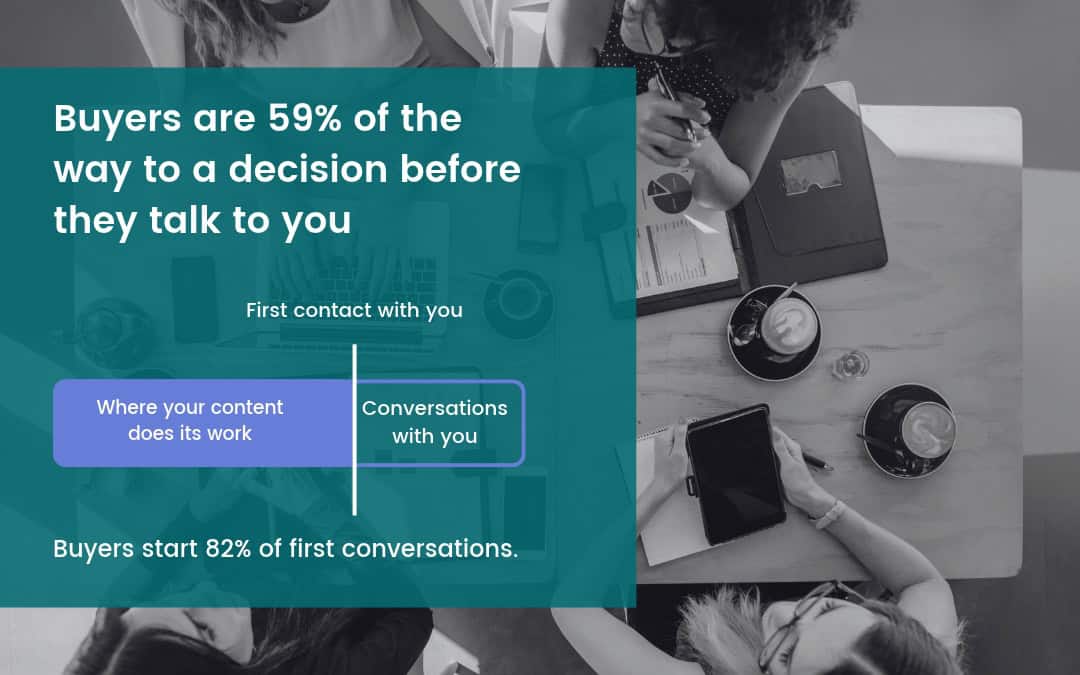
That stretch is where your content lives. When an enterprise buyer is building a shortlist, someone on their team scrolls your founder's feed. When an engineer is asked whether your approach holds up, they look for something you've written about it. None of that shows up as a lead in your CRM, and all of it shapes who gets the call.
Because we work embedded with our clients' teams, we hear about these moments when they happen, and they tend to trace back to posts published months earlier, during a stretch that looked quiet at the time.
What content does for a Series A raise
Before a partner meeting, an investor looks you up, and your content is part of what they find.
Kate, our co-founder, describes that pre-meeting check as a test of consistency. Investors look at whether the story on your website matches the story in your founder's posts, whether credible people are engaging with what you publish, and whether there's real-world proof behind the claims in your deck. A quiet LinkedIn presence won't sink a raise on its own. It does leave a gap, and investors fill gaps with questions.
This matters most for companies without a household name. In the 2025 Edelman-LinkedIn B2B Thought Leadership Impact Report, 53% of decision-makers said strong thought leadership makes a company's brand recognition matter less when they evaluate it. For a Series A clean tech company competing against established OEMs and well-funded incumbents, that's the opening. You can't buy ten years of name recognition before your raise, but you can show how you think.
The same posts also work on more than one audience at once. The investor reading your feed this month sees the same evidence as the utility buyer, the channel partner, and the senior engineer you hope to hire next spring.
How long does it take for content to work?
Content pays off over months and years; it earns its return on lifetime value, not first-month output.
Les Binet and Peter Field's research for the B2B Institute found that brand effects take at least six months to show and keep building for years after that. Yet only 4% of B2B marketers measure the impact of their work beyond six months. Many teams cut or rework their content right before it would have started to pay off.
Clean tech founders already think this way. You’d never judge a solar or storage project by what it earns on day one. You look at its levelized cost of energy (LCOE), which spreads the upfront cost across decades of generation. Your LinkedIn program deserves the same math. A post you publish in month two is still working in month eighteen, when a buyer finds it during their research or an investor scrolls back before a meeting. You put in the effort early, and the payoff keeps coming for a long time after.
Judge content the way you'd judge a project: on its lifetime value, not its first-month output.
What to measure in the first six months
In the first six months, watch the leading indicators. Sales are the lagging one, and they arrive on their own schedule.
These are the signals we track in production for our clients:
- Profile and page visits from target accounts and investors
- Comments and reshares from the right people, rather than total likes
- Inbound messages that reference a specific post
- Content coming up unprompted in sales or investor calls
The last one tells you the most. When a prospect opens a call by mentioning something your founder wrote, the development work is showing up. Keep a simple log of those moments, because they're easy to forget and they're the clearest early evidence that the program is doing its job.
Start development before you need the power
The founders who win their raise or their next major contract are usually the ones who started development early. By the time an investor or enterprise buyer looks them up, the trust is already built, and the first conversation starts from a much better place.
If you're 6 to 18 months from a raise or a major commercial push and want an outside read on what your content should be doing, book an Ignite Call. It's 30 minutes, and it's a diagnostic, not a pitch.