

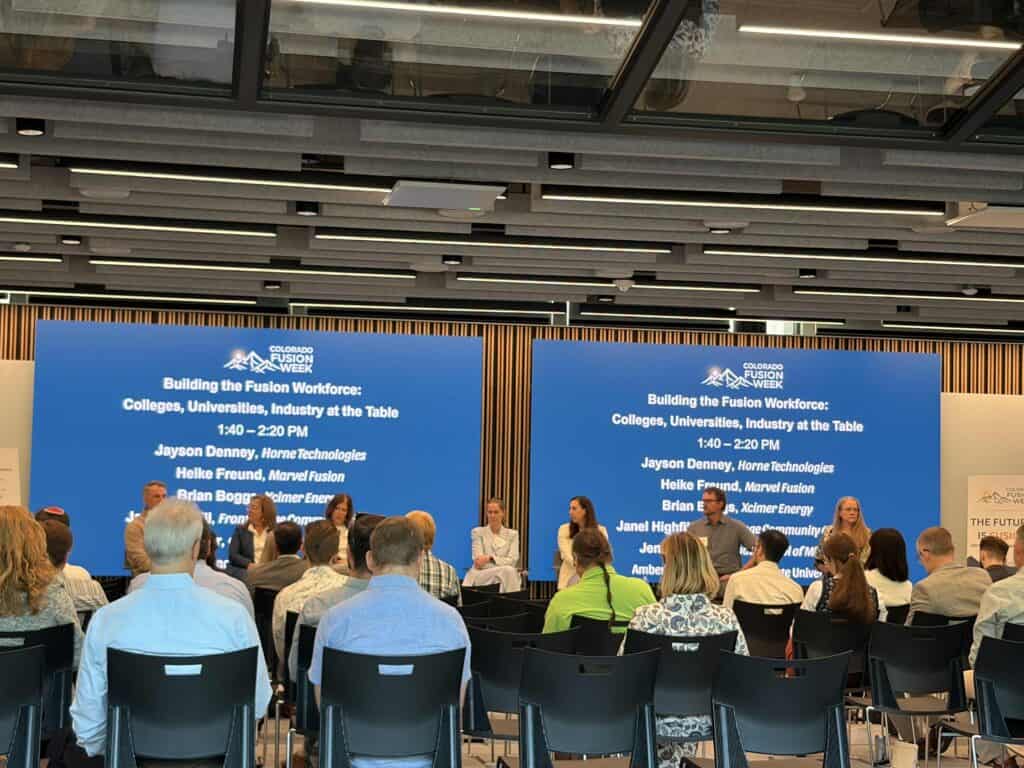
I spent this week at Colorado's inaugural Fusion Week, sitting through presentations from state officials, industry trade groups, venture-backed founders, and researchers who've spent decades chasing net energy gain. The event was organized by Colorado Cleantech in partnership with the CleanTech Alliance, and it's worth calling out just how well-run a first-year conference this was: a packed agenda, lab tours at Marvel Fusion with CSU, Xcimer, and Horne Technologies, and a sold-out room that reflected genuine appetite for this conversation in Colorado. I went in expecting a niche technical conference. I came out with a notebook full of ideas that apply just as much to a solar developer, a battery recycler, or a carbon capture startup as they do to anyone building a tokamak.
Fusion is a useful extreme case precisely because it's so hard and so capital-intensive. When an industry that requires ten-figure checks and forty-year plant lifetimes starts talking seriously about commercialization timelines, the lessons underneath tend to generalize. Here's what stood out.
Clusters aren't planned into existence, but they aren't accidents either
Andrew Holland of the Fusion Industry Association made a point that stuck with me: you cannot simply decide to create an industry cluster. Government can set the stage, but it cannot force one. What actually works is a mix of organic growth and strategic support, almost always anchored by a national lab or major research university, with private firms and spin-outs clustering around that anchor and drawing in suppliers and talent over time.
As he put it: "It is the logic of clusters, economic agglomeration effects. My degree is actually in economics, not science. It is convincing to show that the place where the industry first starts is where most of the economic benefits come from."
He also gave the model a physical limit: the real flywheel effect comes from unplanned, in-person interaction, and that tends to cap out around 30 to 50 miles. Even in a world of Zoom calls, proximity still does something Slack can't replicate.
For any cleantech founder choosing where to locate, this is worth internalizing. Don't just chase the state with the best incentive package. Look at what's already there: the anchor institution, the existing supplier base, the talent pipeline. Xcimer's Alexander Valys made a similar point about Colorado's optics and aerospace legacy (companies like Ball Aerospace and Lockheed built out the state's photonics and precision-engineering base decades before fusion showed up), and that pre-existing industrial ecosystem is a large part of why Xcimer's suppliers were already sitting next door when the company needed them.
Government's job is to enable, not to drive
Governor Polis was direct about this framing: state involvement in fusion is "not driven by government, but enabled by government." Colorado's approach has been to formally fold nuclear (and by extension fusion) into its clean energy portfolio standards, which unlocks financing tools other states don't offer, and to lean on existing academic and lab partnerships rather than trying to manufacture an industry from a standing start.
This is a useful lens for founders navigating state and federal policy in any cleantech vertical. The question isn't "will the government build this for us," it's "what specific policy or standard is blocking capital or infrastructure that already wants to move." Portfolio standard language, permitting timelines, and access to DOE-style milestone funding tend to matter more than headline subsidy dollars.
Broad-based capital is healthier than concentrated bets
One of Holland's more counterintuitive data points: fusion funding this year was more broadly distributed across many companies than in 2022, when a handful of players absorbed most of the money. Five companies have now crossed a billion dollars in cumulative funding, and the median company estimates it needs roughly $1.2 billion more to reach a pilot plant, well short of the outlier estimates north of $10 billion.
His framing, almost verbatim: "You don't need a Manhattan Project-style global investment in fusion... What you need is billions of dollars, not hundreds of billions of dollars." Sustained, ordinary levels of investment applied to a maturing technology. That's a useful reframe for any capital-intensive cleantech category where the temptation is to argue for a single moonshot bet. Multiple parallel approaches, funded at moderate scale, tend to de-risk the sector faster than one enormous bet on a single winner.
Sometimes the best engineering move is avoiding the hard problem entirely
This was my favorite idea from the whole week. Valys described Xcimer's founding insight as an undergraduate engineering lesson: "The best way to solve a hard problem is to figure out some way to avoid it: some loophole, some way to solve an easier problem instead. That is really the approach that we've taken at Xcimer." Instead of engineering around the extreme cost and fragility of solid-state laser optics, Xcimer switched to gas-based lasers and gas optics, effectively removing the problem rather than solving it.
That reframing cascades: cheaper lasers mean you can afford bigger lasers, bigger lasers mean bigger, more forgiving fuel capsules, and the whole cost structure of the plant shifts. It's a good prompt for any founder stuck on a hard technical or unit-economics problem: is there a version of this product where the problem simply doesn't exist, rather than one where you've engineered a clever but fragile solution to it?
Rapid, cheap iteration beats a single expensive device
Tanner Horne's fusion startup, Horne Technologies, takes a deliberately different posture from the big laser and tokamak players: build small, modular, comparatively affordable devices so you can iterate on manufacturing and design quickly, instead of betting everything on a single device that costs hundreds of millions of dollars and takes years to build. In his words: "I look at this as a manufacturing optimization rather than a new scientific device." He was explicit that this is fundamentally an engineering and iteration problem, not a new scientific discovery.
This is a familiar hardware-startup lesson, but it's worth restating in a cleantech context where the instinct is often to build the biggest, most impressive pilot possible to attract investors. Smaller, cheaper, faster iteration cycles frequently teach you more per dollar than one flagship unit.
Diversify revenue before your core product is ready
Several speakers pointed out that fusion companies are already generating revenue in adjacent markets well before a commercial reactor exists: medical isotope production, industrial heat, off-grid power, and even manufacturing and selling components to other fusion companies. Horne's device, for example, targets neutron production for materials research and pharmaceutical isotopes as an interim commercial application while the core fusion technology matures.
For any deep-tech cleantech company with a multi-year runway to a flagship product, this is a reminder to actively look for adjacent, sellable outputs of your R&D process rather than treating the years before commercialization purely as a cost center.
Talent will not simply appear locally, plan to recruit for it
Valys made a blunt observation: "There's no state, there's no city you could go to in the entire U.S., where you could hire all of the workforce that you need to build a fusion company entirely in place. You're always going to have to convince people to relocate from somewhere." Losing a few key people because they won't move, he added, can have real consequences. Colorado's advantage isn't that it has every skill set sitting idle; it's that its cost of living and existing technical base make relocation easier to sell than in coastal tech hubs.
Any cleantech founder scaling a technical team should budget real effort, and real employer-brand investment, into relocation, not just hiring.
Your supply chain is competing with the Pentagon and Nvidia, whether you like it or not
Morgan Bazilian, Colorado School of Mines, gave the talk that probably should have opened the whole conference instead of coming near the end. His starting line: fusion founders tend to assume technology is the constraint, but "it turns out that fundraising and marketing are the key." The plasma physics, in his framing, is largely solved. What isn't solved is the supply chain underneath it.
He walked through around 13 critical materials that show up across fusion, directed energy weapons, quantum computing, and semiconductors: tungsten, enriched lithium-6, rare earth elements for superconducting tape, exotic superalloys, beryllium. The problem isn't that these materials are impossible to source. It's that every advanced-technology industry is drawing from the same limited supply, and fusion is rarely the customer with the most leverage. As he put it bluntly about competing for tungsten and rare earths against defense and AI data center demand: "They're getting much more priority than your technology is."
He also pointed out something that will feel painfully familiar to anyone who has tried to price an unconventional material: commodity markets like oil are liquid and transparent, down to two decimal places, in real time. Markets for things like lithium-6 or specialty graphite are, in his words, "just garbage." Ask a supplier for a quote and you get a wall of qualifying questions (currency, flake type, natural versus synthetic, which country you want to trade in) before you get a number, and by then, as he joked, your board has already kicked you out of the room.
His closing point is the one worth sitting with: "The supply chain is not working, not yet... the clock is running." And critically, this isn't a fusion-specific problem. He named quantum computing and enhanced geothermal in the same breath. Any deep-tech cleantech company sourcing exotic materials, magnets, or specialty alloys is competing for prioritization against defense contractors and hyperscalers with far bigger checkbooks and far more urgent government backing.
The lesson for founders outside fusion: don't wait until you're pouring concrete to map your supply chain in detail. Model out not just where a material comes from, but who else is bidding for the same tonnage, and whether that competition is a market problem you can solve with money or a geopolitical one you can't.
AI is a force multiplier today, not yet a paradigm shift
Dr. Scott Hsu with Lowercarbon Capital offered a grounded take, quoting a colleague: "AI is like having 20 of your best postdocs ever working for you 24/7." It accelerates the people already good at the work. It has not yet produced the kind of revolutionary redesign of how fusion systems are engineered, and he was careful not to overclaim that it will. He also noted something specific to fusion but broadly true of technical fields: AI tools disproportionately benefit early-career people who've grown up with them, because they bring fresh tools to old, well-worn ideas.
That's a useful calibration for any cleantech company evaluating how hard to lean on AI in its R&D roadmap: treat it as leverage for your best people and your newest people, not as a replacement for the underlying physics or engineering work.
The throughline
Almost none of these lessons are actually about fusion physics. They're about how any capital-intensive, deep-tech cleantech company should think about location, capital strategy, engineering philosophy, hiring, and near-term revenue. Fusion just happens to be the version of this problem where the stakes and the time horizons are stretched to their most extreme, which makes the underlying patterns easier to see.
If you're building in solar, batteries, carbon capture, grid infrastructure, or any other cleantech vertical, it's worth asking which of these eight lessons your roadmap is currently ignoring.