
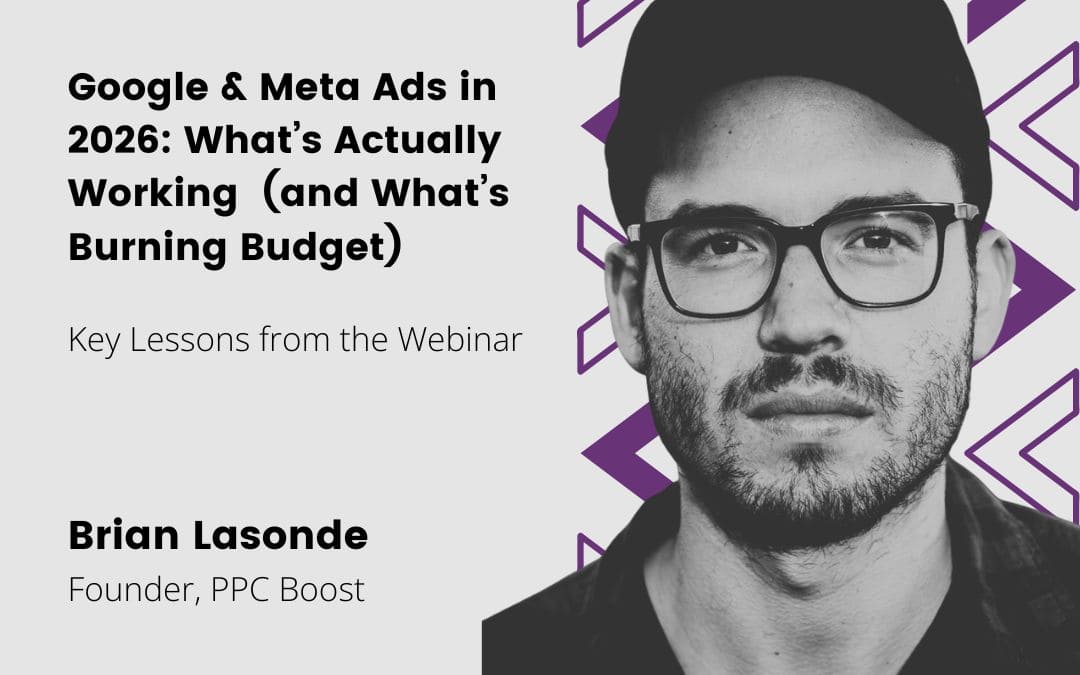
Paid advertising in 2026 is all about doing less, more deliberately.
In our most recent Psyche Digital monthly webinar, we welcomed paid media expert Brian Lasonde, founder of PPC Boost, to unpack what’s actually working in Google and Meta Ads, and where organizations are quietly wasting budget.
This session was especially relevant for founders, CMOs, and growth leaders at lead-generation organizations, where paid spend is often constrained, scrutiny is high, and mistakes compound quickly.
Below are the biggest takeaways from the session, filtered through a strategic lens and grounded in real-world account experience.
TL;DR: The Big Ideas
- Platform “recommendations” are optimized for spend, not performance
- Lead-gen organizations need tighter control, not more automation
- Performance Max is not a default solution—often the opposite
- Exact match keywords are safer than most people think
- Remarketing still matters (despite what platforms imply)
Key Takeaway #1: Don’t Trust Platform Recommendations by Default
One of Brian’s strongest warnings was also one of the most practical:
“Google’s recommendations are designed to increase spend, not necessarily results.” — Brian Lasonde
In both Google and Meta, platforms aggressively push automatically applied recommendations, broad match keyword expansion, and new AI-driven campaign types.
For growth-stage, lead-generation organizations, these changes often show up as subtle but compounding problems. Intent gets diluted as targeting expands beyond what the business actually sells. Lead quality drops, even as click volume rises. And cost per lead quietly increases without delivering better outcomes, creating the illusion of activity without meaningful progress.
A more sensible approach is to slow things down and reintroduce human judgment. Manually reviewing platform recommendations, turning off auto-apply features, and treating suggestions as inputs rather than instructions helps preserve control. In most cases, this discipline does more to protect performance than any new campaign type ever will.
This is also where website content strategy starts to matter more than ever. As AI-powered search tools increasingly summarize, recommend, and surface answers directly, organizations that invest in clear, authoritative, well-structured content are better positioned to show up, without paying for every click. Optimizing site content for AI search is quickly becoming a foundational complement to paid media, not a replacement for it.
Key Takeaway #2: Lead Generation ≠ Ecommerce (Stop Using the Same Playbook)
A recurring theme throughout the webinar was how often lead-generation organizations borrow strategies that were built for ecommerce and apply them wholesale to very different business models. On the surface, the platforms look the same. Underneath, the economics and intent signals are completely different.
For ecommerce, scale and volume often compensate for inefficiencies. For lead generation, especially in B2B or services, quality is the entire game. Brian cautioned that this mismatch is why many teams struggle with Performance Max and other highly automated campaign types.
“Performance Max can work really well for ecommerce. For lead gen? Traffic quality is often mixed at best.” — Brian Lasonde
What tends to work better for lead-generation organizations:
- Standard Search campaigns built around clear intent
- Strict separation between brand and non-brand terms
- Conservative targeting before introducing experimentation
Key Takeaway #3: Exact Match Keywords Are (Still) Your Friend
Despite Google’s continued push toward broad match, Brian emphasized that exact match remains the safest starting point, especially for budgets under $10K per month.
A smart progression looks like this:
- Start with exact match
- Validate conversions and cost per lead
- Expand intentionally, not automatically
“If Google is constantly asking you to switch to broad match, that’s usually a sign you shouldn’t.” — Brian Lasonde
Key Takeaway #4: Negative Keywords Are One of the Highest-ROI Activities
Negative keywords may not be flashy, but they remain one of the most effective ways to protect paid media performance, especially for teams with limited budgets. Brian emphasized that without active search term management, platforms will happily spend money on queries that look related but have no real buying intent.
Over time, this creates a slow leak. Ads appear to be running. Clicks continue to come in. But relevance erodes, cost per lead rises, and performance degrades without a clear moment where something “broke.”
High-impact habits that consistently save budget:
- Reviewing search term reports weekly (daily for new campaigns)
- Building shared negative keyword lists across campaigns
- Proactively blocking irrelevant or misleading intent early
Key Takeaway #5: Remarketing Isn’t Dead. It’s Just Misunderstood.
As Performance Max and other all-in-one campaign types have expanded, many teams assume remarketing is already handled. In practice, this assumption often leaves meaningful opportunities on the table, especially for longer sales cycles.
Brian was clear that while Performance Max may include remarketing elements, it does not replace a dedicated strategy built around message control, audience exclusions, and sequencing.
“Performance Max does include remarketing, but it doesn’t replace a dedicated strategy.” — Brian Lasonde
This is also where creative becomes a true differentiator. As targeting becomes more automated and audiences harder to control, the quality of the story being told matters more than ever. Clear positioning, founder-led narratives, and trust-building messages are often what determine whether remarketing ads feel helpful or get ignored entirely.
What a more effective remarketing approach looks like:
- Dedicated Demand Gen or display remarketing campaigns
- Clear exclusions for existing converters
- Founder-led, testimonial, or trust-building video assets
Where This Leaves Growth Leaders in 2026
For growth leaders, the biggest takeaway from this conversation is not a new tactic or campaign type, it’s a mindset shift. Paid advertising in 2026 works best when it is treated as a precision tool, not a growth shortcut. The days of turning on campaigns, trusting platform automation, and expecting predictable results are effectively over.
What Brian reinforced throughout the session is that strong performance now comes from clarity and restraint. Teams that succeed are not the ones testing every new feature first, but the ones who understand their business model deeply enough to say no to unnecessary complexity. They use paid media to amplify clear intent, not to compensate for unclear positioning or weak fundamentals.
For lead-generation organizations in particular, sustainable success tends to come from a few consistent principles:
- Designing campaigns around true buyer intent, not surface-level keyword volume
- Experimenting deliberately, with guardrails that protect budget and lead quality
- Defining success metrics and business goals before introducing automation
In other words, paid ads are no longer about moving faster. They’re about moving smarter, with systems that support long-term growth rather than short-term noise.
If you found value in this article, then you won’t want to miss the full replay, available on demand anytime HERE.
What’s Next
Watch the Webinar Replay and check out other past webinars.
Replays of all Psyche Digital monthly webinars are available here: https://psychedigital.com/webinars/
Upcoming Webinar – February 19
Trust as a Growth Strategy for Healthcare Organizations
A deep dive into how visibility, credibility, and authority drive growth in highly regulated industries. Register here: ADD When Landing Page is live.
Stay in the Loop
We share upcoming webinars, long-form insights, and practical growth strategy through our newsletter. You can subscribe here: https://psychedigital.com/subscribe/