Introduction: Why this conversation matters
In December, Psyche Digital hosted trademark and IP attorney Seth Gardenswartz of Blackgarden Law for a live webinar on branding and protection. What made the conversation compelling wasn’t just the legal insight, but how clearly Seth connected brand, perception, and long-term business value in a way that felt immediately applicable.
Rather than treating branding as logos and visuals, Seth framed it as something much more consequential: a living asset that grows, weakens, or collapses based on how a business shows up over time and whether it can actually protect what it’s built. Throughout the session, he moved fluidly between brand strategy, psychology, and trademark law, showing how closely intertwined these disciplines really are.
Early in the talk, he set the tone with a deceptively simple reframing:
“The brand is not the logo.”
That statement challenged a common assumption many founders and marketers still hold: that brand work is something you finish, approve, and move on from. Instead, Seth positioned brand as something that compounds over time, shaped by decisions, behaviors, and experiences long after launch day.
What followed was a wide-ranging, practical discussion that challenged assumptions about naming, differentiation, and trademarks. Seth showed why getting these wrong becomes far more expensive as a company grows.
Below are the five core takeaways from Seth’s presentation.
Takeaway 1: Brand Isn’t Design. It’s Meaning Earned Over Time
Seth emphasized that brand is not something you launch fully formed. It’s not your name, logo, or color palette. Those are simply vessels that carry meaning, not the meaning itself.
“It’s the feeling a person has when they encounter that thing.”
That feeling doesn’t exist at the beginning. It develops slowly through repeated experiences with a company, whether those experiences are good or bad, intentional or accidental.
“When you launch your company, your brand doesn’t really mean anything yet… that significance is acquired along the way.”
Using examples like the Edsel, the Titanic, and Kodak, Seth illustrated how brands don’t get to choose what they come to represent. These brands didn’t set out to symbolize failure or missed opportunity. That meaning was assigned later through real-world outcomes.
The takeaway is both sobering and freeing: founders don’t need a perfect brand on day one, but every decision after launch contributes to what the brand ultimately becomes. Meaning is assigned by the market based on what actually happens over time.
Takeaway 2: You Don’t Decide Your Brand. The Market Does
One of the most grounding moments of the webinar was Seth’s reminder that branding is not self-declared. A company can articulate its values, positioning, and aspirations, but none of that guarantees how it will actually be perceived.
Referencing brand strategist Marty Neumeier, he explained:
“The brand isn’t what you say it is. It’s what they say it is.”
Seth then brought that idea squarely into a practical context:
“You can tell me what you want your brand to be. But your brand is what the relevant consumer base thinks it is.”
This reframes branding as reputation rather than messaging. Internal alignment, vision statements, and beautifully written copy only matter insofar as they translate into consistent, credible experiences.
For growing organizations, this is a critical realization: no amount of intention can override lived experience. The market is always forming an opinion whether you’re actively managing it or not.
Takeaway 3: Brand is a living asset that grows or shrinks with every interaction
Seth described brand as something dynamic, not static. He compared it more to goodwill than to a finished deliverable you check off a list.
Quoting Michael Eisner, former CEO of Disney, he noted:
“A brand is enhanced or diminished with each customer interaction.”
Every touchpoint matters, including product quality, service, consistency, communication, and follow-through. Seth compared brand goodwill to a bank account, with positive experiences making deposits and small failures or inconsistencies making withdrawals.
“Even if the product is amazing, those interactions still count.”
This framing helps explain why some brands retain trust even when they stumble, while others lose credibility quickly. Brand strength isn’t built in big moments alone. It’s shaped by the accumulation of everyday interactions.
Importantly, this connects brand directly to execution and operations, not just marketing output. How a company behaves internally often determines how it’s perceived externally.
Takeaway 4: Strong brands create real economic value
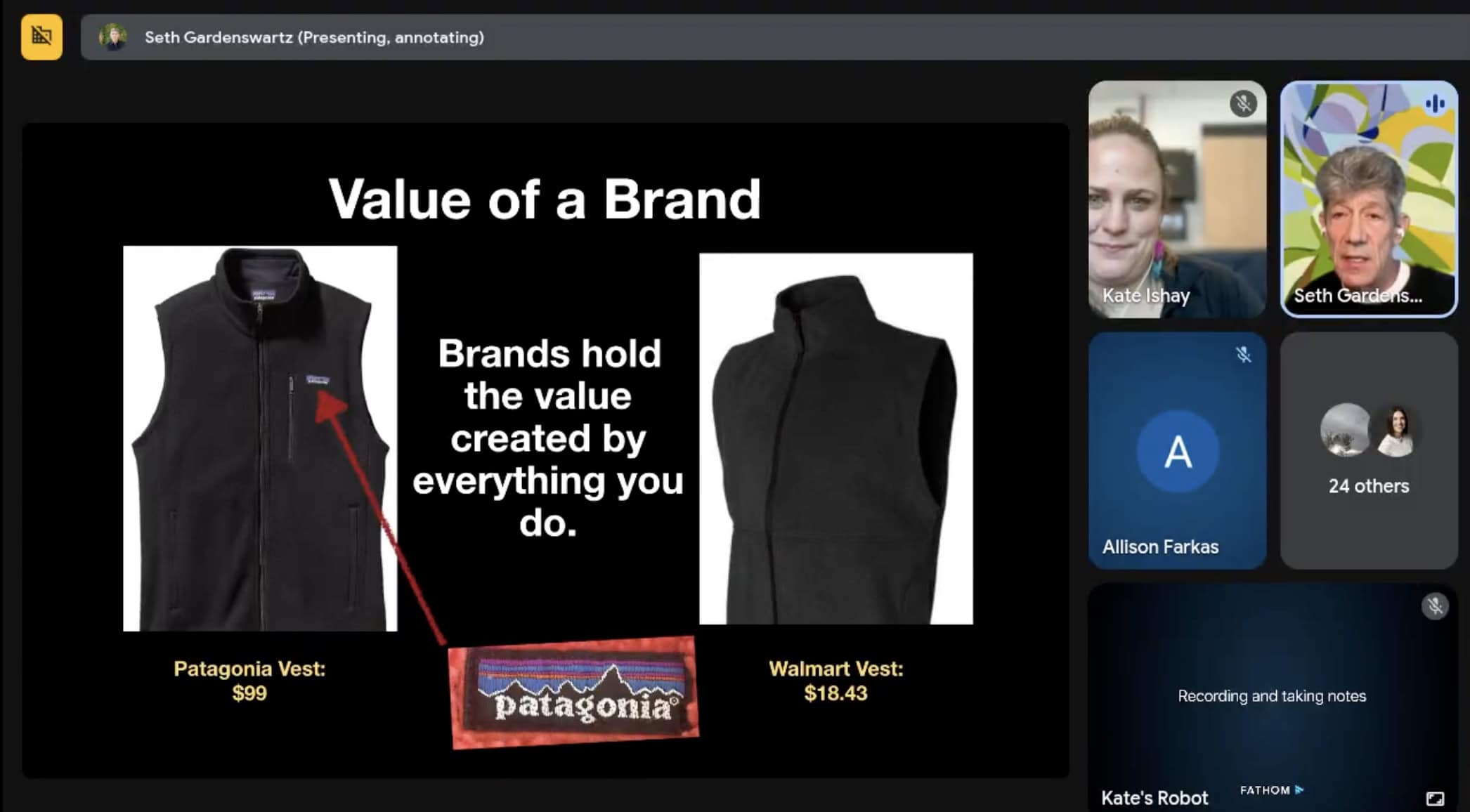
To make brand equity tangible, Seth walked through a simple comparison: a Patagonia fleece vest versus a Walmart fleece vest.
Materially, they’re similar. Functionally, they both keep you warm. And yet, customers willingly pay many times more for Patagonia.
“Is it really five or six times better? And I’m going to say yes. Because I feel more than five times better wearing my Patagonia vest.”
That feeling, and what it signals about values, quality, durability, and identity, is what creates pricing power. The Patagonia label communicates meaning before a single word is spoken.
“It says something about me when I wear it.”
Seth’s point was clear: brand isn’t abstract or sentimental. It directly influences what people are willing to pay, how quickly they choose, and how much trust they extend. Over time, strong brands turn perception into real economic leverage.
Takeaway 5: Protecting a Brand Requires Distinctiveness. Most People Underestimate This
When the conversation turned to trademarks, Seth highlighted a critical mindset shift that many founders experience too late.
Early on, people tend to ask:
“Can I use this brand?”
But once value exists, the question becomes far more strategic:
“Can I stop someone else from using it?”
That’s where exclusivity matters.
“The P in IP stands for property. And you know what you need to have a property right? You need some right of exclusivity.”
In trademark law, exclusivity depends on distinctiveness. Names that are generic or overly descriptive are inherently weaker and harder to protect.
“The more descriptive your brand is, the less distinctive it becomes. And the weaker it is.”
Seth also debunked common myths that give founders false confidence:
“Can I just spell it differently? No. Zero difference.”
Through real-world stories like the Doughboy bakery, D’s Cheesecake Factory, and the Zuzax case study, he demonstrated how early naming decisions can preserve future leverage or create costly constraints down the line.

Conclusion: Build the brand and protect what you build
Seth’s presentation made one thing clear: branding and trademark strategy aren’t separate conversations. They’re deeply intertwined, and ignoring one weakens the other.
Strong brands are built through experience, consistency, and differentiation, but they only become durable business assets when they are distinctive enough to protect. Without that defensibility, growth can actually increase risk rather than reduce it.
As Seth put it bluntly when talking about emotional attachment to names:
“You really like this name. No one cares.”
What matters isn’t falling in love with a name. It’s building something that can grow, earn trust, and remain defensible as momentum builds.
If you want to hear Seth walk through these ideas in full (including the stories, examples, and audience Q&A) we highly recommend watching the full webinar replay.
→ Watch: How to Build a Kickass Brand (And Actually Protect It)