
For many founders and marketing leaders, the phrase “we need a new website” tends to emerge during moments of friction or lag. Maybe the company is preparing for a funding round and the site doesn’t feel investor-ready. Maybe the product has evolved but the messaging hasn’t. Maybe the design feels dated. Or perhaps the brand has grown beyond its original DIY identity and now needs to look credible to customers, partners, and talent.
The instinct to request a website refresh is common and understandable. A website is one of the most visible expressions of a business. When it feels off, the assumption is that a new design will fix the discomfort.
But as we’ve seen across hundreds of founder-led and growth-stage companies, a website redesign rarely addresses the underlying issues. In many cases, the website is not the problem; it’s a symptom of deeper misalignment within the brand, messaging, operations, or marketing ecosystem.
This is where the distinction between a standard website redesign and a Power Build becomes essential. While a redesign focuses on the visual and structural presentation of a website, a Power Build involves rethinking the foundational strategy, story, systems, and brand identity that shape the company’s digital presence as a whole. And from this work, the company’s assets including the website can be redesigned with this strategic alignment at heart.
This article unpacks the key differences between these two approaches, why many teams unintentionally seek the wrong solution, and how to determine the right path depending on your goals, stage, and challenges.
Why Companies Typically Begin by Requesting a Website Redesign
When teams ask for a website redesign, it’s almost always because something feels misaligned. But the triggers are varied:
1. The visuals feel outdated
Teams may feel embarrassed directing people to their site because the design no longer reflects the level of professionalism or innovation the company embodies. This is particularly common for founders who have prioritized product development over brand development in the early stages of growth.
2. The messaging feels unclear or incomplete
If prospects don’t immediately “get” what your product or service does, a redesign seems like a natural next step. But often, the issue lies not with layout but with the underlying story and how your product or service connects to the buyer’s problem.
3. The company is entering a fundraising cycle
Investors conduct their first round of due diligence through a company’s website. If the current site feels amateurish, generic, or inconsistent, teams may conclude that a redesign is the fastest path to credibility.
4. Leadership changes bring fresh expectations
A new VP of Marketing or operations leader may inherit a patchwork of inconsistent materials and see a website refresh as an approachable early win.
5. User experience or conversion issues
When leads aren’t converting or users struggle to navigate key pages, the website becomes the default scapegoat, even if the underlying cause is a lack of clarity, alignment, or systemic structure.
Despite these valid concerns, a redesign alone usually fails to address the underlying misalignments. This is why so many teams rebuild their sites every 12–18 months, only to face the same frustrations again.
The Limitations of a Standard Website Redesign
A traditional website redesign focuses on delivering a refreshed interface: updated visuals, modern styling, a clearer layout, and a more contemporary aesthetic. These updates can make a site feel more professional, but they rarely fix deeper problems.
A redesign typically does not include:
- Clarifying or restructuring the company’s core messaging
- Revisiting audience priorities based on new product-market realities
- Analyzing search visibility or improving SEO foundations
- Rebuilding conversion pathways or nurturing systems
- Auditing or optimizing brand consistency
- Evaluating the tech stack supporting marketing operations
- Standardizing brand assets across channels
- Reworking the underlying site architecture to scale with future needs
In many cases, a redesign is essentially “painting over” the same foundation (with all its cracks, gaps, and inefficiencies still intact).
Founders are often trying to simplify the project or reduce the cost, but in doing so, they remove the very elements required for the website to perform.
What a Power Build Actually Is
A Power Build is not a website project. It is a strategic and systematic reconstruction of the business’s brand, messaging, and digital infrastructure.
At its core, a Power Build begins with the question:
“Why does your business exist and how is that best communicated to your audience?”
Only once that is clear can the design and build process begin.
1. It starts with a Growth Session
Instead of jumping into design, the Power Build begins with a strategic deep-dive that maps out:
- business goals
- audience priorities
- revenue pathways
- product and service clarity
- sales processes
- marketing bottlenecks
- internal team constraints
- competitive positioning
- brand differentiators
Beyond what is discussed, it’s the structure and efficiency of the Growth Session that makes it uniquely impactful. Rather than requiring weeks of back‑and‑forth workshops or heavy involvement from the founder or internal team, the Growth Session is intentionally designed to maximize clarity while minimizing time investment. Most clients contribute just one 90‑minute meeting, during which our team leads with targeted questions, guided frameworks, and prebuilt diagnostic tools. We do the intellectual heavy lifting, allowing founders and VPs to simply respond, reflect, and articulate what they’re observing in the business.
This concentrated approach works because it surfaces patterns quickly: messaging inconsistencies, gaps between audience needs and current positioning, operational friction points, and indicators of brand misalignment. It also allows us to identify not just what isn’t working, but why, and how those issues intersect across the broader marketing ecosystem.
After the session, our team conducts extensive offline research—competitor analysis, SEO review, content audits, market positioning scans—so that clients don’t have to assemble or interpret any of that information themselves. The result is a process that demands very little time from stakeholders while providing a deeply informed strategic foundation.
This diagnostic approach ensures that the website becomes a reflection of strategy, not a guess.
2. Followed by a comprehensive Acceleration Plan
The Acceleration Plan synthesizes:
- findings from the Growth Session
- external research
- SEO analysis
- content ecosystem review
- competitor audits
- evaluation of marketing systems and tech stack
While the Growth Session reveals what’s happening inside the business, the Acceleration Plan contextualizes those insights against the broader environment, including your category, competitors, search landscape, and customer expectations. This combination allows us to design not only a website, but a strategic architecture that aligns brand, messaging, UX, content, and marketing operations.
One of the most significant advantages of the Acceleration Plan is that it compresses what would normally require multiple discovery workshops, internal interviews, and agency back‑and‑forth into a streamlined, low‑effort process for the client. After the Growth Session, we schedule time to present your Acceleration Plan, where insights, opportunities, and recommendations are delivered in a clear narrative.
Behind the scenes, however, the work is substantial. We conduct deep SEO diagnostics, evaluate search intent, map gaps in your current content ecosystem, analyze competitor positioning, and identify where your brand is creating friction or confusion. We also examine your marketing tools and workflows to determine whether automation, integration, or reconfiguration could reduce manual work and improve accessibility.
These insights feed into a cohesive blueprint that clarifies the direction for every major component of the upcoming Power Build: messaging, structure, design, site architecture, content priorities, and technical implementation. The Acceleration Plan allows both the client and the creative team to move forward with shared clarity, minimizing revision cycles and ensuring that all project decisions are grounded in evidence rather than preference.
This approach not only improves project outcomes, it also ensures that a Power Build becomes a long‑term growth asset rather than just a temporary visual refresh.
3. It incorporates brand strategy, not just design
According to Sieana Marketing’s “Website Redesign ROI Statistics: 2025 Report”, consisting of an analysis of 284 website redesigns in 15+ industries, “businesses implementing comprehensive content strategies achieve up to 67% higher returns than design-only focused projects.”
Instead of simply “making things look nicer,” the Power Build includes:
- development of core messaging
- refinement of value propositions
- differentiation and positioning strategy
- brand story articulation
- visual identity upgrades (from color system to typography to logo usage)
A traditional redesign often focuses on surface aesthetics (the equivalent of “throwing a coat of paint” on an existing structure). But if the underlying messaging or positioning does not resonate with your audience, even the most visually impressive website will struggle to engage, convert, or build trust.
Brand strategy addresses the deeper layers that actually shape perception and behavior. It examines how the company is positioned relative to competitors, what emotional and functional outcomes matter most to buyers or investors, and how clearly the value is articulated across all touchpoints.
When these elements are aligned, design becomes more than decoration. It becomes a vehicle for clarity, differentiation, and credibility.
A strategic approach also produces measurable short‑ and long‑term impacts. In the short term, improved messaging and audience alignment increase engagement, reduce confusion, and support the effectiveness of sales and fundraising conversations. In the long term, consistent brand strategy strengthens visibility, credibility, and authority in your category. It ensures your company is not just recognized, but remembered and trusted.
This is why brand strategy is treated as a core component of the Power Build rather than an optional add‑on. It ensures that every visual choice, every page layout, and every line of copy is anchored to a thoughtful understanding of your audience and market. The result is a brand system that feels coherent, confident, and capable of scaling across multiple channels—not just a prettier website.
4. It builds the marketing infrastructure around the website
The Power Build addresses tools and systems that make marketing sustainable:
- CRM integrations
- automated lead flows
- email nurture sequences
- analytics and tracking foundations
- SEO structure and metadata
- content planning and organization
- future-proof site architecture
A website does not operate in isolation; it is the hub of a much broader marketing ecosystem. A redesign may improve visual appeal, but it rarely ensures that the underlying systems actually support lead capture, nurturing, attribution, or long‑term scalability. As a result, teams often launch a beautiful new site only to realize that it still leaves them with manual processes, inconsistent data, or unclear insights.
By contrast, the Power Build establishes the infrastructure that allows marketing to function smoothly and consistently. CRM connections are configured correctly from the start. Automated workflows reduce repetitive tasks and ensure that inquiries, demos, and downloads are followed up with the right messaging. Analytics tools are not only installed but interpreted, providing visibility into which channels work and why. SEO foundations ensure that the site is discoverable in both traditional and AI Search and aligned with the intent of your ideal audiences.
Just as importantly, this infrastructure reduces internal friction and the operational burden on lean teams. When foundational systems are thoughtfully configured, marketing becomes easier to execute, easier to measure, and easier to scale. Teams can focus on strategy and creativity, not chasing down lost leads, deciphering broken funnels, or stitching together data across scattered tools.
In this way, the infrastructure built during a Power Build becomes an accelerant for growth. It allows your brand, content, and marketing efforts to function as a cohesive system rather than a collection of isolated activities.
5. It emphasizes scalability and longevity
Growth-stage companies rarely stay still. As they add new products, markets, or audiences, their digital presence must evolve without requiring a complete rebuild each time. A Power Build creates an underlying architecture that can expand efficiently, saving years of technical debt and rework.
Why a Power Build Solves Problems a Redesign Cannot
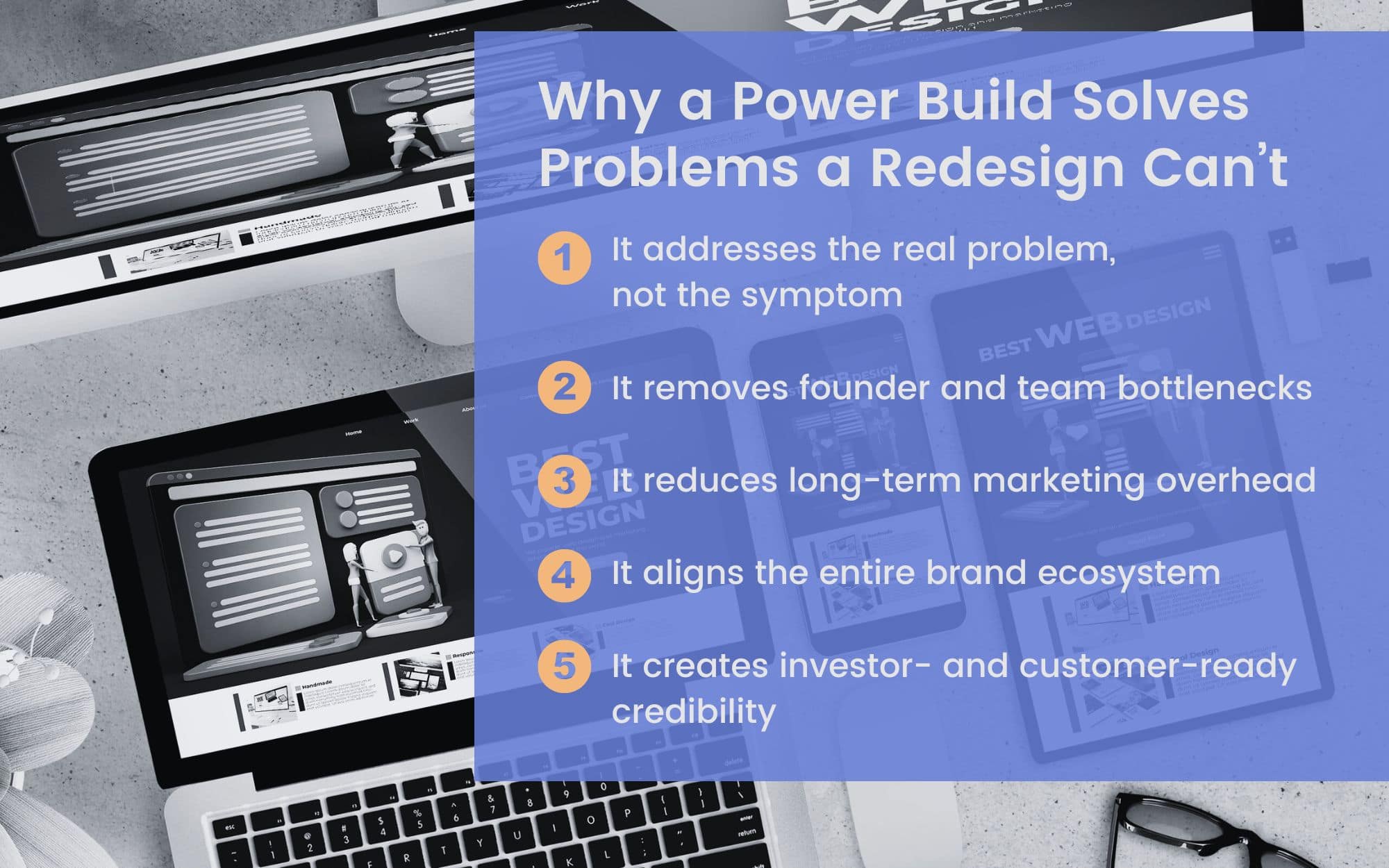
1. It addresses the real problem, not the symptom
If poor messaging, inconsistent branding, or broken systems are the real issues, a redesign will not improve conversions or credibility. A Power Build fixes the foundation.
2. It removes founder and team bottlenecks
Founders often struggle with writing their own copy or articulating their value. A Power Build offers a guided process that translates complexity into simple, intuitive messaging for multiple audiences.
3. It reduces long-term marketing overhead
By centralizing brand guidelines, messaging frameworks, and scalable systems, teams save significant time in future campaigns, hiring, and content creation.
4. It aligns the entire brand ecosystem
From website to sales collateral to social posts to fundraising decks, the Power Build ensures every asset communicates the same story with the same clarity.
5. It creates investor- and customer-ready credibility
For founders preparing to scale, brand perception is not just aesthetic—it directly impacts trust, valuation, and deal flow.
The Role of Confidence and Internal Alignment
One insight that emerges repeatedly is the emotional shift founders feel when their website and brand system finally match the quality of their work.
This may sound intangible, but it has measurable effects.
When founders and team members feel proud of their brand:
- they share their website more proactively
- they communicate with new confidence in pitches
- they reduce hesitation in outreach
- they stop apologizing for confusing or outdated materials
- they create a consistent story across product, sales, and hiring
A redesign can offer some of this relief. But a Power Build creates it sustainably by aligning visuals, messaging, UX, operations, and strategy as one cohesive system.
A Real-World Example: King Energy’s 2x Power Build
King Energy provides a clear example of why a Power Build matters and how it differs from a simple redesign.
Their first Power Build in 2022 equipped them with a cohesive brand presence (both visually and in their messaging) and website aligned with their initial audience and positioning.
But as the company evolved, their audience shifted and their value proposition expanded. Instead of forcing their existing brand system to stretch beyond its limits, they pursued a second Power Build in 2025—this time to reposition themselves for a new market reality.
The result wasn’t just a refreshed website. It was a complete recalibration of their messaging, visual identity, and digital infrastructure to support new goals.
This illustrates a key principle:
A strong initial foundation allows companies to evolve without rebuilding from scratch, but when the business direction fundamentally shifts, the Power Build provides the strategic depth needed to realign everything efficiently.
How to Decide Which Approach You Actually Need
A helpful way to evaluate your needs is by asking deeper questions beyond the surface issue.
Signs you may only need a website redesign:
- Your messaging is already clear, validated, and well-understood by your audience.
- Your brand system is consistent, modern, and accurately reflects who you are today.
- Your SEO foundations are strong, and your site is generating qualified organic traffic.
- Your tech stack—CRM, automations, analytics—is functioning smoothly with no major gaps.
- Your conversion pathways work, and prospects understand how to move through them.
- Your content ecosystem is cohesive and aligned across channels.
- Your website structure already supports your current and upcoming offerings.
- You simply need an updated visual identity or UX refresh to modernize your presence.
Signs you likely need a Power Build:
- Your audience struggles to understand what you do or how you differ from competitors.
- Your brand system no longer reflects your product, category, or positioning.
- Your SEO visibility is weak because foundational structure and messaging are misaligned.
- Your conversion pathways break down due to unclear UX, unclear copy, or missing systems.
- Your content ecosystem feels fragmented or disconnected across channels.
- Your tech stack is inconsistent, outdated, or held together by manual work.
- Your website cannot scale with new products, audiences, or markets.
- Major sales or investor conversations require lengthy explanation because your site does not do that work.
- You can feel the brand and website bottlenecking growth and momentum in multiple areas.
Conclusion
Choosing between a website redesign and a Power Build ultimately comes down to whether you are seeking aesthetic improvement or systemic transformation.
While a redesign can address visual inconsistencies and improve the look and feel of your site, it rarely resolves the deeper, underlying issues related to messaging clarity, positioning, audience resonance, SEO visibility, or operational efficiency.
A Power Build, however, looks beyond the surface to rebuild your digital presence from the inside out, ensuring that your brand, website, and marketing systems are cohesive, scalable, and aligned with your long-term growth goals.
The most important distinction is that a Power Build is not merely about creating a better website—it’s about creating a better foundation for how your company presents itself, connects with customers, and grows over time. By addressing strategic alignment, technical infrastructure, and brand coherence all at once, a Power Build offers a more durable, future-ready solution that prevents repetitive rebuild cycles and provides clarity for both your internal team and your audience.
As companies evolve, their digital presence must evolve with them. The Power Build ensures that this evolution is thoughtful, strategic, and grounded in evidence rather than aesthetics alone.
If you’re curious whether a Power Build is the right fit for your business, you can schedule a no‑risk Ignite Call to talk through your goals, challenges, and what kind of support will help you move forward with confidence.
Key Takeaways
• A website redesign improves visuals, but it rarely fixes underlying issues. If your challenges include unclear messaging, audience confusion, inconsistent branding, or fragmented systems, a redesign alone will not create meaningful or lasting change.
• A Power Build begins with strategy rather than aesthetics. The Growth Session and Acceleration Plan provide deep clarity with minimal time investment from your team, guiding the entire project with purpose and precision.
• Brand strategy is essential, not optional. Audience resonance depends on clear positioning, compelling messaging, and cohesive storytelling, not just attractive design.
• Infrastructure matters as much as appearance. CRM integrations, automation, SEO foundations, and analytics ensure that your website functions as part of a broader marketing ecosystem.
• Scalability must be intentional. A Power Build establishes an architecture that can grow with your company, preventing the need for complete rebuilds every time your product, audience, or goals evolve.
• Confidence is a legitimate business outcome. When your brand system reflects the quality of your work, it strengthens communication, sales conversations, investor relations, and internal alignment.• The right choice depends on your needs. If your brand is already aligned and your systems are strong, a redesign may be sufficient. If you are facing deeper strategic misalignment, a Power Build is a more comprehensive and future‑proof solution.